Who is IQM?
IQM is the only national inclusion award in the UK. For over 20 years and in over 20 countries, schools, MATs and Local Authorities use the Inclusion Quality Mark to recognise exemplary inclusive practice.
Get in touch for your FREE school information pack today.
Mental health or challenging behaviour? A checklist for decoding pupil behaviour
February 9, 2026
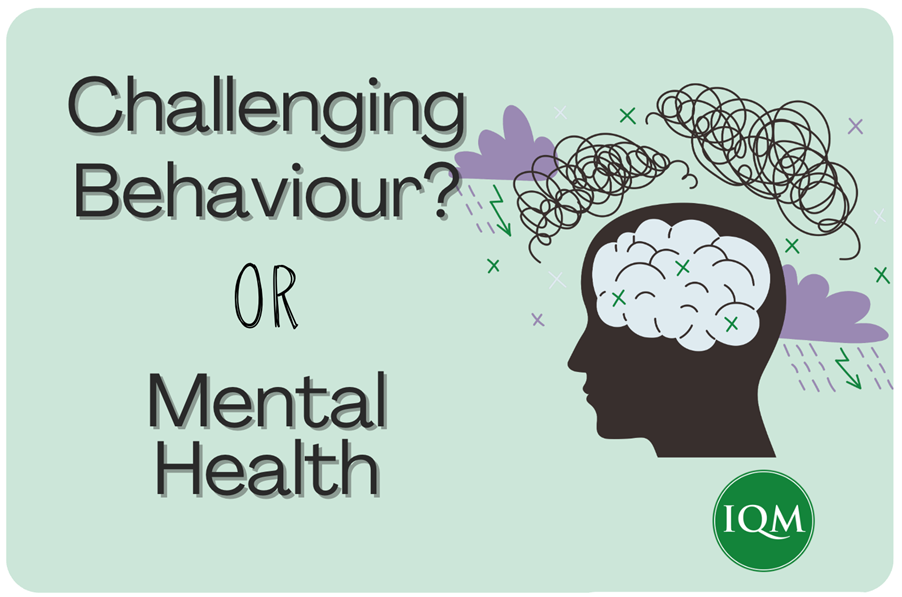
It’s estimated that one in five children and young people aged 8 to 16 is dealing with a mental health difficulty. That works out to roughly five or six pupils in every classroom.
You’ll know as teachers and school leaders that when a pupil needs mental health support, it doesn’t always show up as worry or sadness. Sometimes the request for support looks like disruptive behaviour, task refusal, or withdrawal.
Schools are often the first place where these patterns become visible. With Children’s Mental Health Week in mind, it’s a good moment to look at behaviour through a different lens.
In this article, we explore the reality of children’s mental health for pupils themselves and the school staff supporting them, identify where the pockets of disconnect might be in your setting and use a 5-question checklist for after-the-moment teacher reflection.
Children’s mental health: the reality for pupils
While mental health struggles can affect anyone, data shows that some pupils are navigating a much steeper path.
- SEND pupils are over five times more likely to struggle with their mental health than their peers.
- Recent research found that neurodivergent adolescents experience twice the emotional burden at school compared to their neurotypical classmates.
- When poverty is paired with other mental health risk factors (like SEND, gender, ethnicity and speech language and communication needs) pupil development is significantly impacted.
There’s a vicious cycle involving mental health difficulties and low attainment.
Low attainment leads to mental health challenges, and mental health challenges also lead to low achievement.
Therefore, those pupils at greatest risk for poor mental health, are those who have significant barriers to their achievement and wellbeing.
SEND pupils have the largest attainment gap when compared to non-SEND peers, begin to combine more risk factors like eligibility for Free School Meals (FSM), summer-born pupils and SLCN and the predictions for mental health difficulties increase.
This burden is often invisible until it’s impossible to ignore.

The growing waiting list
In 2023, nearly one million children were referred to mental health services (CAMHS), yet only 32% actually entered treatment. Meaning schools are holding tens of thousands of pupils who need specialist support but can’t access it.
When these pupils struggle to cope due to internal or external barriers to learning and wellbeing, school behaviour management systems often react with sanctions over support.
While overall school suspensions saw a slight dip recently, they actually rose for pupils with an EHCP.
Schools know the core group of who’s vulnerable to mental health challenges and now must reflect on if whole-school behaviour management strategies explore the root causes or just punish the symptoms.
The pressure on teachers and leaders
Teachers, SENDCos and school leaders are currently spinning more plates than ever.
You’re expected to deliver, monitor and improve a high-quality academic curriculum while also overseeing the complex personal and social development of every pupil. Although this is not a new expectation, it is increasingly more challenging when schools are expected to do more with less.
Across all schools there’s a deep-seated desire to create an environment where every child belongs, but desire alone isn’t enough to achieve meaningful change for pupil mental health.
When a pupil’s behaviour becomes challenging, a natural human response is often to react rather than respond to the behaviour as a tool of communication.
Every adult has the ‘choice’ to react or respond, but that choice depends entirely on the tools available in the toolkits they have access to. Their own internal emotional intelligence toolkit and the school-wide toolkit supported and encouraged by the behaviour management and inclusion policies.
If the only tool available is a punitive behaviour policy, then that’s what will be used.

School leaders must design change, not just desire it
The challenge for school leaders is to move from a desire for inclusion to a deliberate design for it.
This means utilising frameworks that give whole-school structure whilst allowing staff to stay curious even when they feel challenged.
When staff are encouraged to look behind the behaviour with curiosity, the teacher worry that a pupil’s behaviour is a personal attack, or a result of poor behaviour management skills lessen.
A thoughtful, whole-school approach to mental health and behaviour focuses on gathering information about what might not be working, rather than who’s at fault.
What pupils need from schools
At the core of every display of challenging behaviour is a pupil who wants to belong.
They want to be understood, even if they don’t yet have the self-awareness tools and experience to understand themselves.
Pupils don’t wake up wanting to be deemed as difficult. They use the communication tools that have worked for them previously or the ones they have most frequent access to in moments of high stress.
More often than not, pupils are looking for an environment where they are accepted as they are. A classroom where they don’t have to mask or fight just to exist. And the first step to creating these environments? You’ve guessed it… relationships.

The wants and needs of school staff
Achieving an environment where children excel and grow, whilst feeding the wants and needs you have as a professional is the common goal for many in schools. In all types of schools across the UK and internationally, the balancing act of supporting a class full of individuals is becoming unmanageable.
The goal is to move beyond the individual firefighting that classroom teaching staff and SENDCos are consumed with daily towards whole-school inclusive practice.
Teachers want school-wide inclusive design that anticipates needs rather than just reacting to them. This involves shifting the focus from managing the pupil to adapting the environment.
When the system is designed for diversity, the pressure on individual teachers starts to lift.
Mental health and behaviour management: Where’s the disconnect?
Even with the best will in the world, inclusion can fail when it hits the reality of school life.
Funding is the most obvious hurdle. Without the correctly deployed resources or staffing capacity, the task of moving towards inclusive schools can seem an overwhelming task.
A lack of shared knowledge can also create support gaps. If only a handful of staff understand the why behind a behaviour, the rest of the staff are at a disadvantage. Falling to default or traditionally used behaviour management strategies that don’t align with the pupils (and often the teacher’s) needs.
Inconsistency of approach when supporting SEND pupils or pupils requiring mental health support is akin to pouring water into a cup with several holes. It can fall to the chosen few to manage and regulate a pupil. Relying heavily on those staff members whilst being incredibly high risk for pupil success should a key staff member be absent or leave the setting.
If a pupil relies on one key person to integrate into your school, your systems for inclusion are in the hands of luck. Luck that the key person doesn’t fall ill or leave the school, luck that your school budget can cover their role long-term, and luck that what is working currently keeps on ‘working’.
True inclusion is a whole-school culture. If the policy says explore but the practice says punish, inconsistent behaviour management and mental health support are a given.
The risk
As school leaders, you’re relying on your team’s consistent ability to respond rather than instantly react to mental health requests that present as challenging behaviour.
Factoring in that your staff team are also human, and have their own challenges outside of school life, they may be tired, hungry, ill and stressed, leaving the capacity to respond and not react diminished.
Staffroom checklist for decoding behaviour
Here are some questions to support your teachers to respond to the mental health communication rather than react to the presenting behaviour. These are designed for reflection rather than in-the-moment responses.
What’s the story I’m telling myself?
Am I assuming they’re being disrespectful, and is that belief actually correct? (If you find yourself answering yes to the belief and supporting it with ‘because’, that’s still a story).
How am I feeling?
Has this pupil’s reaction made me feel defensive or out of control? Acknowledging your own emotional state is the first step to a calm response.
What are the triggers?
Look at the environment, the routine, and the task. Did something happen before school that’s left them with a low tolerance capacity?
What’s this behaviour ‘buying’ them?
Are they getting social validation from peers, or are they successfully avoiding a task that makes them feel like a failure? Are they just desperate for a connection they don’t know how to ask for?
What are the steps to repair?
Relationships are everything. Once the crisis has passed, how can you drop the story of disrespect and show the pupil they’re still a valued part of the community?

How IQM supports whole-school inclusion
Inclusion Quality Mark (IQM) helps schools move from the desire for inclusion to a robust, sustainable design.
We provide an Evaluative Framework that gives you evidence to identify areas of strength and next steps for whole school inclusive practice.
Flexible to the context of individual school types and challenges, the IQM Inclusive School Award is a recognised school accreditation and supportive process for schools prioritising inclusion this year.
For information on joining the IQM family of schools and the benefits accessed with the awards, request your free school information pack.
More articles you’ll like:
Inclusion and AI: Is this finally the end of ‘one-size-fits-all’ teaching?
How AI in Education is making inclusive practice possible in 2026
Other Posts


About IQM
The only national award for inclusion in the UK, IQM has been committed to recognising exemplary inclusive schools for over 20 years and in over 20 countries around the world. The three awards allow schools and organisations to celebrate their inclusive practice against nationally recognised framework.
Site Links
© 2026 Inclusion Quality Mark | website developed & cared for by digidoda