Who is IQM?
IQM is the only national inclusion award in the UK. For over 20 years and in over 20 countries, schools, MATs and Local Authorities use the Inclusion Quality Mark to recognise exemplary inclusive practice.
Get in touch for your FREE school information pack today.
How AI in Education is making inclusive practice possible in 2026
January 9, 2026
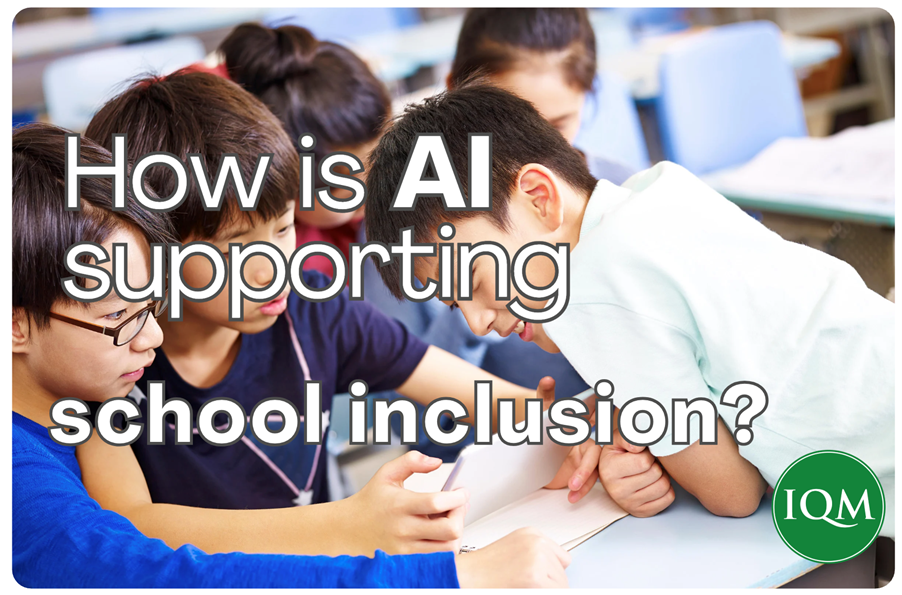
The question for schools isn’t whether AI is coming. It’s what it gets used for.
When AI in education aims to enhance existing inclusive practice by removing barriers and giving teachers time back, it strengthens school inclusion in practical, visible ways.
In this blog, IQM shares what inclusion can look like when AI tools are used effectively.
With expert insights from George Barlow and Ricky Bridge, you’ll find examples of how Belgrave St Bartholomew’s Academy uses technology as the vehicle for inclusive practice, the foundations they treat as non-negotiable, and the impact they’ve seen so far.

George Barlow and Ricky Bridge are all about technology that makes school life better for everyone. They value AI tools that give teachers time back for what they do best, teach!
George is the Principal across Belgrave St Bartholomew’s Academy and St Michael’s Community Academy, and Ricky is the Digital Learning Lead at Belgrave. Together, they’ve helped embed a consistent approach across St Bart’s Multi Academy Trust’s 23 schools, prioritising inclusion and building a culture of support and innovation.
Belgrave St Bartholomew’s Academy achieved the IQM Centre of Excellence Award in 2024 for its dedication to whole-school inclusion and was recognised as an Apple Distinguished School in 2022. Their recent 2025 Ofsted inspection recognised the positive impact their use of technology has on identifying and supporting SEND needs across the school.
Clarity before we explore further
What does AI in education mean?
AI in education usually falls into two categories: teacher-facing and pupil-facing.

George and Ricky define AI in education as a supportive friend, helping teachers create effective systems that give them time back for what matters: teaching, building strong relationships, and helping children achieve, belong, and thrive.
The team at Belgrave see AI as teaching and learning tools that take on the ‘robot work’ teachers already do, the types of teacher-admin that zap time and have low impact on pupil outcomes.
What inclusion in schools looks like when AI tools are used effectively
As with all school improvement projects, the approach to inclusive practice must be tailored to a school’s needs and to the current staff team’s confidence and knowledge levels for it to be successfully embedded.
Let’s look at what you’d expect school inclusion to look like when AI tools work hard behind the scenes:
Reducing access barriers
Access is usually the first barrier. Pupils can struggle to engage with learning for all sorts of reasons, some obvious, some much quieter.
Used well, AI can make inclusive practice easier to achieve by removing barriers to learning and wellbeing, building pupil confidence, and helping every child access learning in their own way.
Understanding internal and external barriers
Sometimes the barriers to learning are external. The instructions are too long, the language is tricky, the format doesn’t help, or the pace moves on before they’ve even found their footing. That’s when pupils don’t get started, not because they won’t, but because they can’t.
Other times, it’s internal and easier to miss. Avoidance can look like refusal or challenging behaviour, when it’s really a pupil protecting themselves from embarrassment, shame, or the fear of getting it wrong. Asking for help takes confidence and trust in their relationship with the teacher, but also relies on an inclusive classroom culture.
More ways to access learning
This is where technology can help. It gives pupils more than one way into the same learning, like replaying instructions, reading at their own pace, or accessing support without always pausing their learning. It can also free up teacher time so staff can be more present, build relationships, and step in early.
Belgrave’s innovative AI approach
Belgrave’s 1:1 iPad approach, where every child has an iPad for learning, expands teachers’ options for reducing barriers to access. All teachers and pupils use iPads, and they still write using smart pens. The difference is, they have more teacher-planned supports available during their lessons.
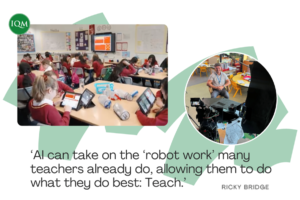
Ricky puts it clearly, ‘AI can take on the admin-heavy robot work, while teachers stay in charge of the learning, building skills, and making knowledge stick.’
Building independence and metacognition
Inclusive practice is about giving pupils strategies for learning, not just helping with a task at a time. Metacognition at its root is teaching pupils strategies for long-term learning that work for them. That might be knowing how to ask for clarity, how to break a task down, or what to do when they hit a barrier.
Metacognition matters for all pupils, but it matters even more for pupils with SEND because the attainment gap is still wide.
At the end of key stage 2 in 2025, 29% of pupils on SEN support met the expected standard in reading, writing and maths combined, compared with 62% of pupils overall. For pupils with an EHCP, it was 9%.
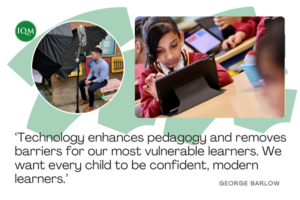
George is clear on the long-term learning benefits for the pupils using a 1:1 iPad approach, ‘We want all of our pupils to be confident and competent, modern learners. Using technology to assist with their learning, not as a substitute for creative problem-solving.’
Teachers stay in control and accountable
The task for teachers is to ensure they have complete control over pupil AI usage and oversight of the support that can be accessed. The DfE recognises that generative AI must be introduced with a strong proactive safeguarding assurance.
All teachers should have a secure and developing awareness of the risks of using pupil-facing AI. Teachers can use AI to streamline admin-heavy tasks, but with overall accountability and direction coming from the teachers themselves.
How Belgrave prioritises inclusion using technology
Belgrave’s approach has been built over time. George, Ricky and their team are clear on what they want technology to do for inclusion, and they’ve been deliberate about the foundations that make it safe and sustainable.
Start with purpose, not AI tools
Ricky encourages leaders to start with purpose, understand the ‘why’ and have the following questions at the forefront when planning to introduce AI to your school:
- What aspects of the school’s culture and ethos will be enhanced through AI use?
- What barriers will AI aim to reduce and remove for pupils and teachers?
- What will improve short and long-term for pupils and teachers if low-impact tasks utilise AI?
Safeguarding comes first
The introduction of AI in schools requires careful handling, with a working risk assessment a non-negotiable.
Safeguarding needs to cover data protection, bias, and pupils interacting with believable nonsense that sounds right but isn’t.
A proactive mindset to change
George is honest that staff worry policies will be out of date as soon as they’re written because AI moves so fast. But he’s clear this isn’t a reason to avoid it. It’s a reason to lead it. AI is already here, so the job is to make it happen safely for teachers and pupils, not sit back and let it happen to schools.
Time back for teachers
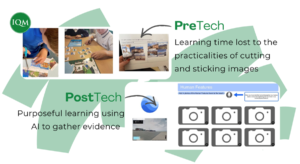
At Belgrave, that includes reducing teacher admin tasks so attention can return to children, creating flexible routes to the same learning, and helping pupils stay on track when they feel stuck.
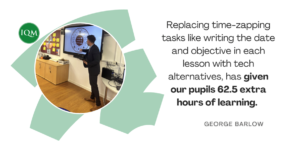
Teacher time is one of the largest inclusion resources a school has. George highlights over 7.5 hours per teacher saved per week through their 1:1 iPad approach and streamlined workflows. Across the year, that’s around 23.12% of directed time freed up.
That time can be reinvested into planning access, being present in lessons, building relationships with pupils and families, and creating the kind of consistency that keeps barriers from creeping back in.
Learn with others, not in isolation
Schools don’t need to do this alone. Expert input helps leaders sense-check decisions, keep safeguarding a priority, and learn what has and hasn’t worked elsewhere. It can also support staff confidence and buy-in because the learning feels grounded and practical.
George recommends tapping into trusted companies, charities, support networks and professional communities, including LinkedIn, so schools build a circle of practice rather than navigating change in isolation.
Strong staff support
A whole-school approach only sticks when staff feel supported. Belgrave’s technology journey began in 2019 and has been built through routines, training, and space for staff to ask questions and learn.
Strong staff support matters because inconsistent practice is one of the quickest ways to create new barriers. Ongoing support helps staff use tools confidently, share what works, and keep expectations aligned so pupils experience the same inclusive approach across classrooms.
Embedding inclusion first
Technology doesn’t create an inclusive culture from scratch. It can only strengthen what’s already there. Belgrave’s focus is inclusion as the baseline, with technology used to make it easier to deliver consistently.
Their approach to inclusion means the same learning goal, but more flexible routes in, more chances to show understanding, and fewer pupils relying on adult rescue to access valuable learning.
The end goals stay human, championing belonging, progress, and confidence. AI is simply one of the tools that helps remove barriers and make inclusive practice sustainable.
How IQM helps schools to embed inclusion
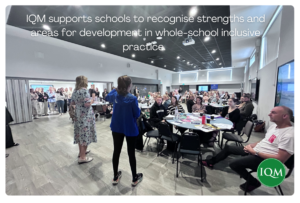
Inclusive practice doesn’t stick because a school has good intentions. It sticks when there’s a shared understanding of what inclusion looks like, how it’s lived day to day, and how leaders know it’s making a difference. This is what IQM supports schools to build.
For schools navigating change, whether that’s shifts in pupil need, staffing pressures, inspection focus or technology introduction, having a clear inclusion framework makes decision-making simpler.
It helps leaders keep inclusion as the main priority, using tools and systems to strengthen what works and reduce barriers to pupil learning and wellbeing over time.
IQM helps schools capture what success looks like for their pupils, their community and their priorities, while still holding high expectations for consistency and accountability.
Request your free school information pack and learn more about how IQM works with schools like yours.
More articles you’ll like:
Ofsted 2025: What the new Framework means for inclusion and SEND
Supporting children with ADHD in the classroom
The Children’s Commissioner Report 2025: What this means for mainstream inclusion
Other Posts



About IQM
The only national award for inclusion in the UK, IQM has been committed to recognising exemplary inclusive schools for over 20 years and in over 20 countries around the world. The three awards allow schools and organisations to celebrate their inclusive practice against nationally recognised framework.
Site Links
© 2026 Inclusion Quality Mark | website developed & cared for by digidoda